By the Aatomobil Editorial Desk · Updated November 20, 2026 · 10-minute read
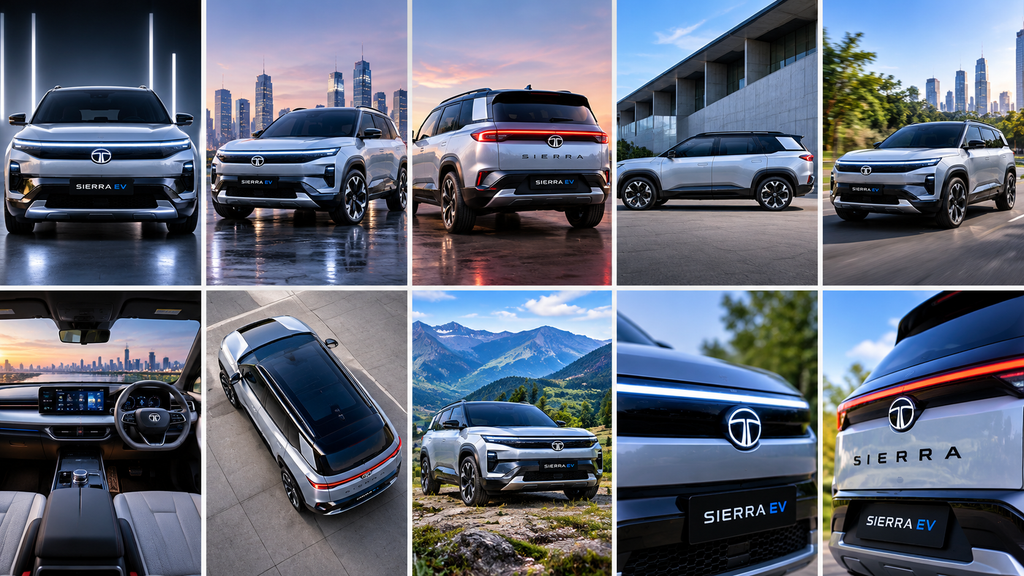
Image Disclaimer: Images used in this article are AI-generated illustrations created for visual representation and editorial purposes. They are not official photographs released by Tata Motors and may not accurately represent the production vehicle’s specifications, design details or features.
Come, sit with me a while at the roadside, and let us talk about a car.
The Tata Sierra EV reached Indian showrooms in June 2026, wearing a name that many of us remember fondly. The original Sierra was a boxy, glass-wrapped SUV that a whole generation admired from the pavement, saying quietly, one day. Now the Tata Sierra EV returns with a battery under its floor, a silent drivetrain and a claim of up to 665 km on a single charge.
But I have learned that a claim and a kilometre are not the same thing. So I will tell you what Tata says, what independent testers found, and where the two part ways. Let anyone with ears to hear, hear.
How this guide was made. Aatomobil has not logged its own test miles on the Tata Sierra EV, and I will not pretend otherwise. Everything here comes from Tata’s published specifications and from road tests, first drives and price listings by Autocar India, CarTrade, 91wheels and others, all named at the end. Where sources disagree, I say so. Prices change, so confirm with an authorised Tata dealer before you sign.
Tata Sierra EV at a Glance
| Detail | What the sources say |
|---|---|
| Launched | June 2026, India |
| Price (ex-showroom) | From ₹18.79 lakh; top variants about ₹26 lakh |
| Battery options | 63 kWh and 75 kWh |
| Layouts | Single-motor rear-wheel drive or dual-motor all-wheel drive |
| Claimed range (MIDC) | 535 km (63 kWh), 665 km (75 kWh RWD), 624 km (75 kWh AWD) |
| Tested range (75 kWh AWD) | About 437–438 km |
| AWD output | 140 hp front + 209 hp rear, 504 Nm combined |
| Boot | 622 litres (measured to the roof), no spare wheel |
| Platform | Acti.ev+, shared with the Harrier EV |
| Battery warranty | Tata’s “lifetime” cover, which means 15 years from first registration |
Tata Sierra EV Price in India: Count the Cost First
Which of you, wishing to build a tower, does not first sit down and count the cost? So let us count.
The Tata Sierra EV starts at ₹18.79 lakh ex-showroom. For the top of the range, Autocar India’s range test lists ₹25.99 lakh, while other listings, including CarDekho, show ₹26.48 lakh. The gap is small, but it reminds us that prices and variants shift, and that the ex-showroom figure is only the first coin on the table. Registration, insurance and accessories follow, so ask for the full on-road quote.
The Tata Sierra EV also arrives in crowded company. The Hyundai Creta Electric starts at ₹18.03 lakh, the MG ZS EV at ₹17.99 lakh, the Kia Carens Clavis EV at ₹17.99 lakh, and, one rung higher, Tata’s own Harrier EV at ₹21.79 lakh. These are starting prices from Autocar India and 91wheels listings, so compare like-for-like variants, not headlines.
Battery, Motors and Platform: What Lies Beneath the Floor
The Tata Sierra EV shares its upper body with the petrol and diesel Sierra, but it rests on Tata’s Acti.ev+ architecture, the same foundation under the larger Harrier EV. There are two battery packs, 63 kWh and 75 kWh, and two layouts: a single rear motor, or a dual-motor all-wheel-drive setup.
Autocar India tested the AWD version. It pairs a 140 hp induction motor at the front with a 209 hp permanent-magnet motor at the rear, for 504 Nm of combined torque, and it weighs 2,130 kg. Its 75 kWh battery uses lithium iron phosphate (LFP) cells, a chemistry known for durability and thermal stability. You get four drive modes (Eco, City, Sport and Boost) and four regeneration levels from L0 to L3. Launch coverage cited a 0–100 km/h time of about 5.8 seconds.
On the battery warranty: Tata advertises it as “lifetime”, which Autocar India explains in practice means 15 years from first registration. One dealer listing gives the vehicle warranty as three years or 125,000 km. Read the fine print, as you would with any covenant.
Which Tata Sierra EV Variant Makes Sense?
Many ask me, “Which one should I choose?” The honest answer depends on your road.
The 63 kWh pack, claimed at 535 km, is the smaller option. If your days are mostly city errands and school runs, it may be all you need. The 75 kWh rear-drive car carries the longest claim, 665 km, and is the natural choice for someone who often travels between cities. The AWD adds a second motor and more traction, but it also adds weight, and its tested range was about 437 km against 624 km claimed. Unless you need the extra grip or performance, it is fair to ask whether the single-motor car serves you better. Test-drive both before deciding.
Tata Sierra EV Range: Claimed vs Real-World, A Sermon on Honest Miles
Tata’s certified (MIDC) figures are 665 km for the 75 kWh rear-drive car, 624 km for the 75 kWh AWD, and 535 km for the 63 kWh versions. These are laboratory numbers, and the road is not a laboratory.
Autocar India put the AWD through its real-world test in Mumbai, driving in Eco mode with regeneration at L3 in the city and L1 on the highway. The car returned 5.83 km/kWh in the city and 5.82 km/kWh on the highway, which works out to about 438 km and 437 km respectively. That is roughly 70 percent of the 624 km claim. The city run took place in around 40°C heat, and the air-conditioning compressor never cut off, which hurt efficiency.
So what do I say to you? Do not despair, and do not be deceived. A range of 437 km is still a Mumbai–Pune round trip with room to spare. But plan on the tested figure, not the brochure, and remember that this test covered only the AWD variant. The 63 kWh and rear-drive cars will behave differently, and your own speed, load and weather will decide the rest.
Charging the Tata Sierra EV: The Patience of the Bay
Tata says the battery goes from 20 to 80 percent in 26 minutes on a 120 kW DC fast charger. Autocar India used a 240 kW charger and recorded 35 minutes for 20–80 percent, then another 39 minutes to reach 100 percent. The peak speed it saw was about 90.3 kW, below what Tata’s figure implies.
The lesson is old and simple: do not rush the last mile. On a long journey, charge to 80 percent and go, because the final 20 percent asks a great deal of your time. For daily life, the better answer is a home charger, where the car fills quietly while you sleep. Before buying, check that your parking spot and your society’s wiring and rules allow one.
Design and Cabin: Light Through Many Windows
From the outside, the Tata Sierra EV looks much like its combustion sibling. Small differences mark it: the front drops the full-width blacked-out band between the light bar and the headlamps, and the “SIERRA” lettering above the emblem is gone. You also get 19-inch alloys, flush door handles, a 540-degree camera system with a transparent underbody view, a powered tailgate with gesture control and a digital key. Colours seen in listings include Pristine White, Pure Grey, Nainital Nocturne and Rishikesh Rapids.
Inside, three screens span the dashboard: 12.3-inch infotainment and passenger displays and a 10.25-inch driver display. Add dual-zone climate control, powered and ventilated front seats, and a panoramic sunroof of about 1,525 by 925 mm. Reviewers praise the airy cabin and the generous rear legroom, with even a slight backrest recline.
Yet truth demands the shadows too. Autocar India found quality inconsistencies and ergonomic missteps, and scored interior space and comfort 7 out of 10. CarTrade notes there is no privacy mode for the passenger screen, and 91wheels says front space may feel tight for drivers over six feet.
Boot Space and Practicality
The Tata Sierra EV offers 622 litres of boot space, but this is measured up to the roof. Autocar India estimates about 450 litres by the conventional parcel-tray method, which is still generous. On the same roof-height measure it beats the Harrier EV’s 502 litres. Bear in mind that the spare wheel is gone, replaced by a puncture repair kit. There is also a small front trunk, which one listing puts at 55 litres, handy for the charging cable. Ground clearance is listed at 205 mm.
Safety and Technology
Six airbags are standard, and the top trim adds an extensive Level 2 ADAS suite with adaptive cruise control, lane-keep assist, blind-spot detection, autonomous emergency braking and traffic sign recognition. A surround-view camera system helps in tight parking. The software, Tata’s Activ.ev OS, is described by reviewers as mostly smooth and lag-free.
One honest caution: I did not find an independent crash-test rating for the Tata Sierra EV in the sources I reviewed. Before you trust any safety claim, check the Bharat NCAP and Global NCAP results yourself.
Driving Impressions: Quiet Power, Gentle Manners
I report here what those who drove it have said, not what I have felt. Autocar India judged the Tata Sierra EV to be Tata’s most convincing new car in years, praising the most refined powertrain the brand has built. It scored performance and refinement, and ride and handling, 8 out of 10 each. The strong L3 regeneration setting can feel abrupt at first, and you will need a few days to make peace with it. If you are the kind of person who likes to lift off the accelerator and let the car slow itself, you will learn it quickly. If you are not, start at L1 and move up in your own time.
Tata Sierra EV vs Its Rivals
| Model | Starting price (ex-showroom) | Battery | Claimed range |
|---|---|---|---|
| Tata Sierra EV | ₹18.79 lakh | 63–75 kWh | 535–665 km |
| Tata Harrier EV | ₹21.79 lakh | 65–75 kWh | Up to 627 km |
| MG Hector Tomahawk EV | ₹19.50 lakh | 69.2 kWh | 517 km |
| Kia Carens Clavis EV | ₹17.99 lakh | 50.3 kWh (as listed) | 461 km |
These figures are compiled from public listings and should be verified. The Harrier EV is longer and wider and shares much of its hardware with the Sierra, but the Tata Sierra EV is slightly taller and offers the bigger boot. Against the Kia and MG, the Sierra’s argument is its larger claimed range and cabin space for the money. Its counterweights are a higher price at the top end and the gap between claimed and real-world range that we saw above.
Who Should Buy the Tata Sierra EV, and Who Should Wait
Blessed are the families who need room and have a place to plug in at home, for this car will serve them well.
Blessed are the city commuters who take the occasional highway trip, for a tested 437 km is more than enough for them.
But wait a little, friend, if you depend on public fast chargers for frequent long highway journeys, since the charging speeds seen in testing fell short of the claim. Wait, too, if you are tall and sit with long legs in front, and test the seat first. And wait if the lowest sticker price is your only measure, for the Creta Electric and ZS EV start slightly lower.
Tata Sierra EV Pros and Cons
Pros
- Claimed range of up to 665 km, with 437 km tested on the AWD
- Large boot and a comfortable, roomy rear seat
- Triple-screen cabin, sunroof, ventilated seats and Level 2 ADAS on the top trim
- Smooth, refined powertrain with an AWD option
- Battery warranty of 15 years from registration
Cons
- Tested range was about 70 percent of the claim in hot conditions
- Peak charging speed seen (about 90 kW) was below expectations
- Quality inconsistencies and some ergonomic flaws
- No spare wheel, only a puncture repair kit
- Top variants cost close to ₹26 lakh
Frequently Asked Questions About the Tata Sierra EV
What is the Tata Sierra EV price in India? It starts at ₹18.79 lakh ex-showroom and rises to about ₹26 lakh for the top variants, depending on the listing.
What is the real-world range of the Tata Sierra EV? Autocar India’s test of the 75 kWh AWD recorded about 437–438 km, against a 624 km claim. Other variants have not been covered by that test.
How long does the Tata Sierra EV take to charge? In testing, 20–80 percent took 35 minutes on a 240 kW DC charger. Tata claims 26 minutes on a 120 kW charger.
Does the Tata Sierra EV have a spare wheel? No. It comes with a puncture repair kit.
What is the battery warranty? Tata calls it a lifetime warranty, which Autocar India explains as 15 years from first registration. Confirm the terms with your dealer.
The Road Ahead
The Tata Sierra EV is neither miracle nor mirage. It is a spacious, well-equipped electric SUV with a smooth drivetrain, a long claimed range and a fair, if not flawless, real-world showing. It asks only that you meet it honestly: plan around the tested range, charge at home when you can, and test-drive the variant you actually intend to own.
Go in peace, drive gently, and charge before the last kilometre. And if you have already driven the Tata Sierra EV, tell us in the comments what you found, for the best testimony is the one that comes from the road.
Sources and Disclosure
Figures were checked on November 20, 2026 and may change. This article is for information only and is not financial advice.
- Autocar India: Tata Sierra EV launched at Rs 18.79 lakh
- Autocar India: Tata Sierra EV real-world range tested, explained
- Autocar India: 2026 Tata Sierra EV review
- Autocar India: Tata Sierra EV vs Harrier EV compared
- CarTrade: Tata Sierra EV first drive review
- 91wheels: Tata Sierra EV launched at Rs 18.79 lakh, 665 km claimed range
- ETV Bharat: Tata Sierra EV launch coverage
- CarDekho: Tata Sierra EV price and variants